
The timing of training may shape gains
Collaborators

By Sarah C.P. Williams

Canva Pro Images
When it comes to building endurance, most people focus on how far or fast they go. But a new study suggests there’s another variable worth paying attention to: the time of day you exercise.
Research funded in part by the Wu Tsai Human Performance Alliance found that when mice trained early in their daily active cycle, their endurance improved more over six weeks than mice that trained later in their schedule. Those gains were true even though the early training group began with lower endurance and completed less overall exercise.
But if you already have a dedicated afternoon or evening workout routine, don’t race to change your schedule, said Karyn Esser, the physiologist at the University of Florida who led the study, which was published in the Journal of Applied Physiology. The results are more complex than that, and mostly underscore the importance of a consistent schedule.
“The important idea here is that exercise and the circadian system are actually partners,” said Esser. “If there is a regular pattern of activity, your internal clocks will recognize that and adjust accordingly.”
Like most cells in the human body, each muscle cell contains a molecular clock. That clock directs a cycle of gene activity that repeats roughly every 24 hours, helping coordinate metabolism, protein production, and physical function across the day. In both mice and humans, studies have previously shown that endurance performance naturally peaks later during the active, awake hours (close to dawn for nocturnal mice, in the late afternoon for humans). At the beginning of the new study, mice tested later in their active phase ran about 83% farther than those tested earlier in the night.
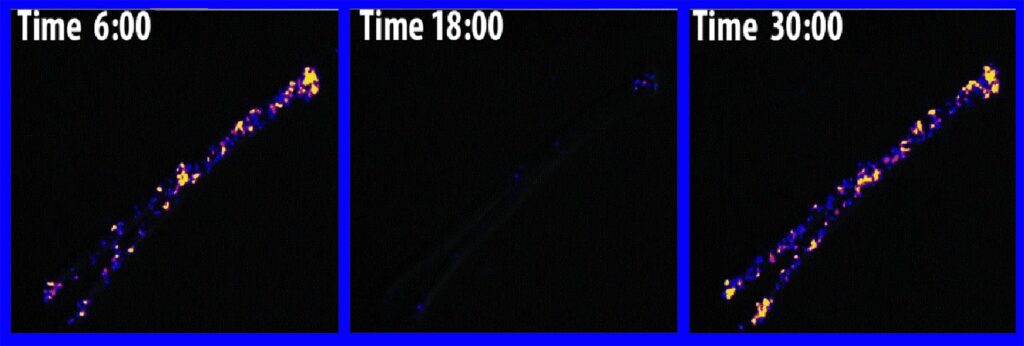
Image credit: Karyn Esser. The levels of many genes in muscle tissue change throughout the day. Here levels of the circadian clock gene PER2 cycle from high (bright spots shown at 6 hours), to low, and then high again.
Then, Esser’s team put the animals on a training plan. All mice followed the same protocol for six weeks: five days a week of treadmill running at 70% of each animal’s maximum capacity. The performance gap in distance run—with late-exercisers beating out early-runners—persisted for the first three weeks. But by week 6, the early-training group had fully caught up, matching the late-training group’s performance despite having started with lower endurance and completed training with less total work.
“It was absolutely a surprise,” said Esser. “We knew they would adapt with training, but not to that extent.”
In addition to the endurance gains, both groups lost the same amount of fat, despite the early-training mice doing less total exercise.
To pin down what was happening at a molecular level, the researchers measured proteins in the mice’s muscle tissue. A protein called COX IV, involved in how mitochondria convert nutrients into cellular energy, stood out. Levels of COX IV were higher than normal only in the early-training group.
Esser and her colleagues suspect that consistent training early in the active phase gradually shifted the muscle clock, which in turn drove higher COX IV levels and made mitochondria more efficient at that time of day. That, in turn, could have been what helped the early-training group close the performance gap despite doing less total work.
For competitive athletes, Esser said the takeaway message from the work is about consistent exercise timing. Train at the time you plan to compete, she said. Then, your muscle clock will be well-adapted to perform at its best at that hour.
Understanding exactly how the muscle clock drives these adaptations could eventually point to new ways to help people whose clocks are disrupted, including older adults, whose circadian rhythms naturally weaken with age.
“If we can better understand these molecules, we might be able to figure out ways to boost muscle clock output in people who struggle with endurance, such as older adults and people with chronic diseases,” said Esser.
The findings add to a growing body of research suggesting that not only does the circadian clock impact exercise ability, but exercise timing actually resets the circadian clock. This may help explain why movement is one of the most effective tools for managing jet lag.
“Most people who travel a lot have figured that out,” said Esser. “It doesn’t have to be a heavy hardcore workout, but moving your body is just as important as getting sunshine and eating for telling your body what time of day it is and adjusting your clock.”
Esser’s group is continuing studies in mice to better understand molecular links between muscle performance and the circadian clock. They are also collaborating with clinicians and other scientists testing time of day exercise strategies to boost the muscle clock as a means to support mobility and metabolic health in older adults and patients with chronic diseases.
This research is part of the Wu Tsai Human Performance Alliance Agility Project Program and supports the Alliance’s mission to discover the molecular changes that occur during peak performance and recovery.
Latest News

September 24, 2026
Wu Tsai Human Performance Alliance welcomes Emory Human Performance Institute, expanding Innovation Hub network
September 22, 2026
Alliance Round-Up: REDs risk markers, heat and iron absorption, and more

September 8, 2026
A wearable device tracked over 42,000 menstrual cycles. Here’s what researchers found
Get Engaged
Join our mailing list to receive the latest information and updates on the Wu Tsai Human Performance Alliance.