
What makes a racing shoe fast? A Stanford ultrarunner cut one open to find out
Collaborators

Today’s elite racing shoes have helped runners set new world records. A Stanford engineer who studies shoe foam in the lab, and races on it in the mountains, wants to know which shoe is fastest for you.
By Kristy Hamilton
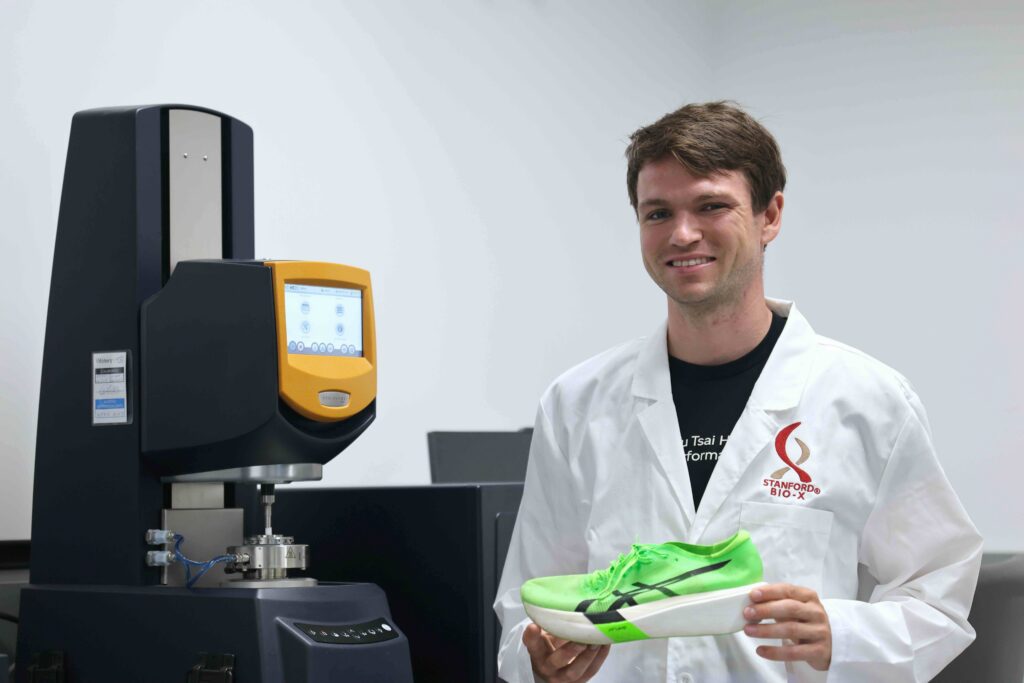
Jeremy McCulloch holding a racing shoe next to the rheometer at Stanford University. Image credit: Kristy Hamilton
It’s 3am in the Austrian Alps, and Jeremy McCulloch is alone in the dark. The 90-kilometer (56-mile) Pitztal Glacier Ultratrail race started at 11pm to get runners off the exposed peaks before the valley’s afternoon thunderstorms. The course climbs 17,000 feet, and for the first several hours McCulloch ran by headlamp, seeing only a few feet ahead.
“It was kind of peaceful,” he said. “Just on your own and running in the dark.”
That changed around 4:30am, when the rain showered down, turning the trail into a muddy, slippery mess. Soaked and cold, he slowed and focused on staying warm, moving one foot in front of the other. In the misery, he forgot to eat. He remembers thinking, “I just want this to be over, and I’m not even halfway done.”
Sunrise and some food revived his spirits, and he finished in second place in 15 hours and 45 minutes.
McCulloch is a graduate student in mechanical engineering at Stanford, who studies the foam inside high-performance racing shoes, or “super shoes” as runners call them. They are light shoes built around a stiff carbon-fiber plate and a springy foam.
Since their debut, runners have set new world records at nearly every road distance, and studies have found that the shoes cut the energy cost of running by up to 4 percent. Yet the companies that make them closely guard how their shoes are made, and what properties contribute to how they behave on the road.
McCulloch’s research puts numbers to the shoe foam. How much energy does it return to the runner? And his bigger goal is a question many runners ask while browsing dozens of expensive shoes: Which shoe is fastest for me?

Jeremy McCulloch running the Pitztal Glacier Ultratrail race in 2026. Image Credit: Sportograf
From running on foam to studying its properties
McCulloch grew up in San Diego, and he didn’t like running in elementary school. By middle school that changed, and he joined cross country through high school. At MIT, he studied mechanical engineering, focusing on solid mechanics. He kept running on the side.
At Stanford University, he joined the lab of Stanford professor of mechanical engineering Ellen Kuhl, which builds computational models of how soft materials deform, and about a year ago, it led him to the foam inside racing shoes.
“What I love about Jeremy’s project is that it connects his passion for running with a fundamental question in mechanics,” Kuhl said. “We know these racing shoes can make elite athletes faster, but what about the millions of recreational runners? Are they really worth the hype?”
Three features, McCulloch said, set modern racing shoes apart from everyday shoes: They are extremely light, a carbon-fiber plate stiffens the sole against bending, and the foam gives back a good share of the energy a runner puts into it.
“It’s like a spring,” he said. “When you land, it absorbs a lot of energy, and then when you push off the ground, it gives almost all the energy back to you as opposed to dissipating it.”
The carbon plate is what made many racing shoes famous, but with top models weighing about the same these days, the foam may be an important distinguishing factor.
To test this idea, McCulloch’s team chose the ASICS METASPEED™ series, one of today’s most popular elite racing shoes. It uses two proprietary foams, FF LEAP™ and FF TURBO PLUS™. ASICS sells two versions of the shoe, one for stride length and one for cadence. The main difference between them is which foam sits above the carbon plate and which sits below.
So the team peeled off the rubber outsoles, sliced the foam away from the plate with a hot wire, and punched out samples. They tested the foam three ways: stretching (tension), squashing (compression), and twisting (shear). Together, those tests roughly capture the forces on a shoe during a stride. The study is published in Engineering with Computers.

Samples from the ASICS METASPEED™ Sky and Edge racing shoes. Image credit: Jeremy McCulloch.
What the tests revealed about both foams
Both foams were stiffest in tension, less stiff in compression, and least stiff in shear. Both also returned between 90 to 94 percent of the energy put into them when stretched or compressed.
Surprisingly, the biggest difference was shear force. FF TURBO PLUS™ was about 42 percent stiffer when stretched and nearly twice as stiff when twisted compared with FF LEAP™. In the METASPEED™, that means swapping which foam sits where changes how stable the shoe feels.
The shear force response matched what McCulloch felt on the road. The shoes are tall and “anytime you turn a corner, you’re pushing sideways on the shoe, and it doesn’t feel particularly stable,” he said.
For a road marathon, the 26.2 miles are mostly run in a straight line, McCulloch thinks the trade-off is worth it. On a rocky alpine trail at 3am, stability may be more valuable than saving energy.

“I enjoy being able to do research that relates to what I do for fun in my personal life.”
– Jeremy McCulloch
A custom equation for each foam
Next, the team wanted a mathematical description of each foam in order to predict how it behaves under load. This way, their team and other researchers could build a running shoe into their simulations.
The usual machine learning models that learn to spot a cat in a photo from millions of examples wasn’t an option here. “We get very limited data from these experiments,” McCulloch said. “If we were to use standard machine learning models, they would capture the data well, but they wouldn’t do a very good job at predicting anything that wasn’t used in the training data.”
So the team built physics into the network instead. “We added the laws of thermodynamics and some symmetry properties that we know about the material,” McCulloch said. The result is a “specific type of neural network that does a better job at predicting than the generic neural networks. It’s still machine learning, but to make up for the lack of data, we use physics.”
The resulting equations matched the measurements almost perfectly in all three tests.
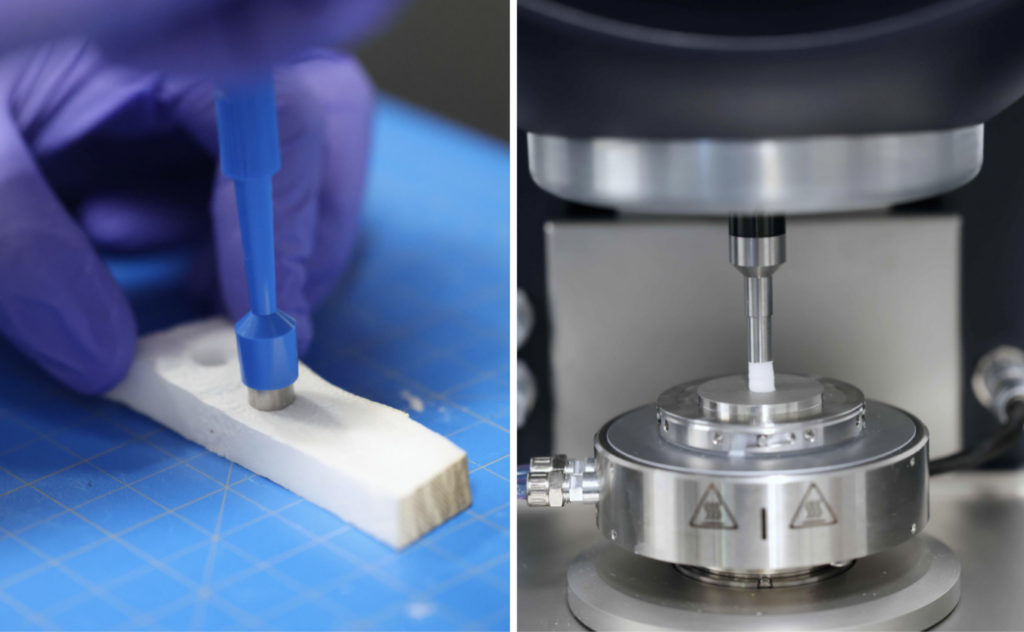
A hole-punched foam sample being compressed in the rheometer. Image credit: Kristy Hamilton
How many miles does shoe foam last?
A follow-up, pre-print study turned up two surprises. The first: the foam isn’t the same from heel to toe. ASICS markets each foam as a single material, but the team found it was stiffer at the heel and less stiff at the toe.
The second was durability. Runners often hear that a racing shoe loses its spring after 100 miles or so. So the team compared foam from a brand-new shoe with foam from a pair of running shoes McCulloch had run 300 miles in. They found no statistically significant difference in stiffness or energy return.
“I expected it to change after 300 miles,” he said, “but was surprised to see that it actually lasted.”
The result comes from one shoe model and one runner, so more work is needed before keeping shoes for 300 miles becomes general advice.
A shoe for every runner
The team’s upcoming goals are to model the whole shoe, then pair it with a model of a person running. “There’s so many questions that you could ask,” McCulloch said. “For a given person, what shoe will make them the fastest? How does their running style impact it? How does their foot shape impact what shoe would be the best?”
Today, he says, most runners pick a racing shoe by checking what the record-setters wore but “it’s not like one shoe is the best for everyone,” he said. “The best shoe for me and the best shoe for you and the best shoe for someone else might be different shoes.”
“And beyond that, what excites me most is that this research goes far beyond running shoes,” Kuhl said. “If we understand how these ultra-lightweight foams store, return, and dissipate energy, we could apply the same design principles to soft robots, next-generation prosthetics, or lightweight protective materials for aerospace. What if the most exciting thing about a racing shoe isn’t how fast it makes us run, but what it can teach us about engineering?”
As McCulloch continues his research, he is also still running, including triathlons with the Stanford Triathlon team. “I’m more productive at work if I’ve done some physical activity in the morning.”
Or perhaps, every now and then, through the night.

Jeremy McCulloch racing to the finish line of a triathlon for the Stanford team in 2024. Image credit: Caly Poly Triathlon
This research was supported by the Wu Tsai Human Performance Alliance at Stanford, including McCulloch’s Digital Athlete Fellowship. Co-authors are Ellen Kuhl and Scott Delp.
Latest News
November 10, 2026
What makes a racing shoe fast? A Stanford ultrarunner cut one open to find out

November 3, 2026
What thousands of games reveal about travel, jet lag, and performance in the WNBA

November 2, 2026
Study suggests no need to time iron tests around menstrual cycle
Get Engaged
Join our mailing list to receive the latest information and updates on the Wu Tsai Human Performance Alliance.