
Sprinting and the Nordic hamstring exercise stress the hamstring in different ways
Collaborators

A new Stanford University study finds that sprinting and the Nordic hamstring exercise place different demands on the hamstring, and that the two may complement rather than replace one another.
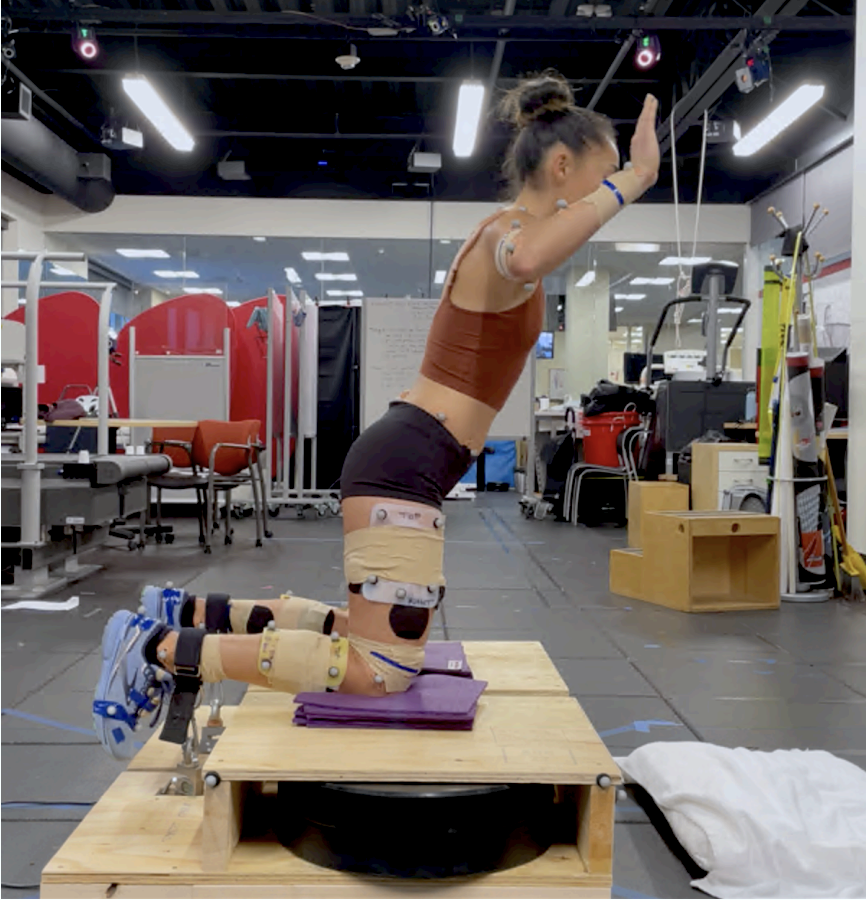
Image credit: Julie Muccini. Experimental setup for assessing biomechanical measures during the Nordic Hamstring Exercise.
Walk into an NFL training room, Major League Soccer warm-up, or a college track facility and you will likely find some version of the same drill: athletes kneeling on a pad, ankles pinned, lowering themselves slowly toward the floor. The Nordic hamstring curl is the go-to exercise for preventing hamstring strains. A new Stanford study published in the Journal of Biomechanics suggests the Nordic exercise and sprinting stretch the hamstring in different ways, and that athletes likely need both to prevent strains.
Hamstring strains account for roughly 12 percent of injuries in soccer and 17 percent in track and field, sidelining athletes for around three weeks at a time. Most happen at full speed, which is why the Stanford team asked: Does the Nordic exercise resemble what hamstrings do during a sprint?
Co-first author Kristen Steudel, a member of the Wu Tsai Human Performance Alliance, said the idea grew out of earlier work in her lab suggesting Nordic training could lengthen the hamstring’s muscle fibers. That finding, she said, raised a follow-up question: How do the mechanical demands of the Nordic compare with sprinting, where the hamstring fibers also lengthen?
The team gathered motion capture and force-plate data from 14 athletes who sprinted on a treadmill, then performed Nordic exercises in the lab on the same day. They built personalized digital athletes from that data to estimate how the biceps femoris long head – the most commonly torn muscle in hamstring strains – was stretched and loaded in each athlete.
They found that muscle actually does similar amounts of braking work during Nordic exercise and sprinting (over 7.5 meters per second or ~17 mph), counterbalancing the forward motion in both movements. This finding surprised Steudel because a single Nordic repetition takes about four seconds and the stretching portion of a sprint stride lasts less than a tenth of a second. The much shorter time for a sprint stride means the muscle is generating a tremendous amount of force to do similar work.
During sprinting, the biceps femoris stretched to longer lengths and at higher speeds than during the Nordic. Those conditions, Steudel said, are precisely when the muscle is most vulnerable to tearing.
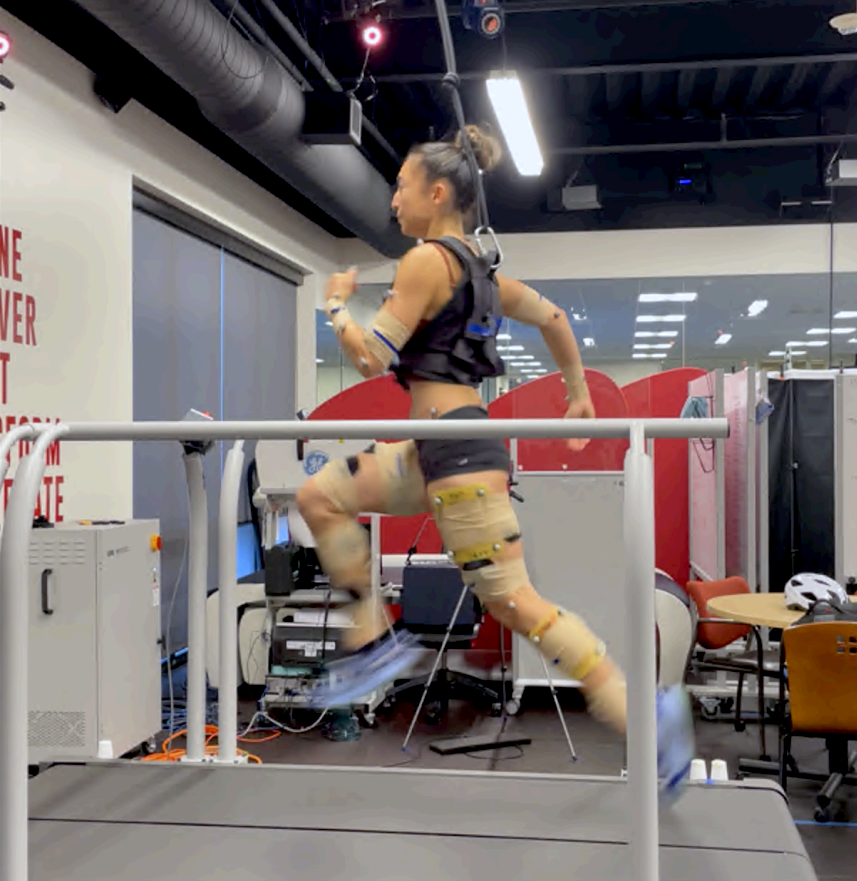
Image credit: Julie Muccini. Experimental setup for collecting running data on an instrumented treadmill with motion capture and electromyography units. Participants wore a harness attached to ceiling beams for safety.
At those extremes, sarcomeres – the muscle’s tiny contracting units – “can be stretched too much, which reduces the force the muscle can withstand.” The modeling, she added, shows the biceps femoris reaches its peak length about halfway through the flight phase of running, the window when hamstring strains most often occur.
The Nordic never reaches those extremes. It does, however, demand more total energy from the hamstring to resist the stretch compared with running below 7.5 meters per second. In short: the Nordic fatigues the hamstring; sprinting takes it to the edge of failure. It’s the difference between keeping a rubber band stretched out moderately over a long time and yanking it as hard as you can.
Many coaches already pair sprinting with strength work, Steudel said, but the new study gives that combination research backing. She suggests the conversation should shift away from which exercise is better toward “how can we optimally combine both exercises to prepare hamstrings for the multifaceted demands of high-speed running?” The Nordic, she added, becomes especially valuable when an athlete is recovering from a lower-body injury that limits sprinting; sprinting, in turn, exposes the hamstring to conditions the Nordic cannot reproduce.
What the study does not settle is whether one exercise prevents more injuries than the other. Nor does the modeling capture what individual muscle fibers do, as opposed to the muscle and tendon as a whole. That fiber question, Steudel said, is already partly answered in a follow-up paper using simulations to estimate what individual hamstring fibers do during the two exercises. Further out, she would like to develop a hamstring injury risk metric to predict which athletes are most likely to suffer a tear.
For now, the message to athletes and coaches is to keep both in the program. The Nordic builds the hamstring’s capacity to absorb load; sprinting prepares it for the speeds where strains actually happen.
This work is part of the Wu Tsai Human Performance Alliance Digital Athlete Moonshot.
Co-authors include Kristen Steudel, Nicos Haralabidis, Reed Gurchiek, Jennifer Hicks and Scott Delp.
Latest News

September 24, 2026
Wu Tsai Human Performance Alliance welcomes Emory Human Performance Institute, expanding Innovation Hub network
September 22, 2026
Alliance Round-Up: REDs risk markers, heat and iron absorption, and more

September 8, 2026
A wearable device tracked over 42,000 menstrual cycles. Here’s what researchers found
Get Engaged
Join our mailing list to receive the latest information and updates on the Wu Tsai Human Performance Alliance.