
Biking 2,850 miles across America
Collaborators

Cy Chittenden biked 2,850 miles across America. His DNA is part of a Stanford study searching for the genetics of elite athlete endurance.
By Kristy Hamilton
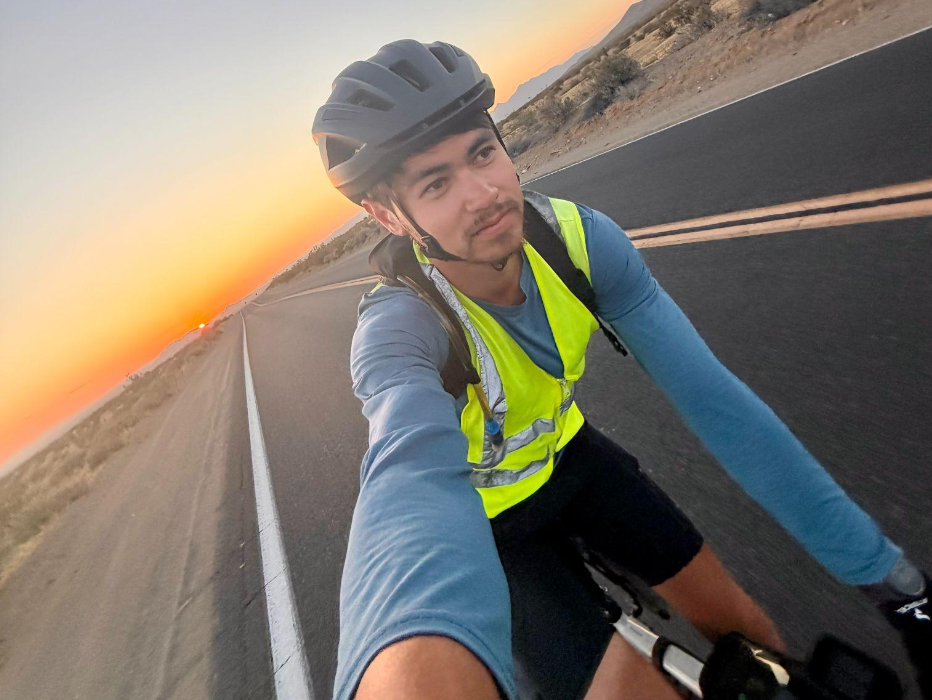
Image Credit:Cy Chittenden. Sunrise ride on the final day out of Barstow, CA
Somewhere in rural Kentucky, Cy Chittenden was trying, once again, to outpedal a pack of wild dogs that had become an unwelcome fixture of the Appalachian Mountains. He was one week into a nearly 3,000-mile solo ride from Richmond, Virginia, to Manhattan Beach, California.
Thousands of miles away, in a Stanford freezer, a tube of his DNA was waiting to be sequenced. The freezer holds roughly 2,000 samples in all. Each contains a full human genome of three billion base pairs, which researchers are reading for clues to what makes an elite endurance athlete elite.
Most medical research focuses on people who are sick. The ELITE Study takes the opposite approach, searching for gene variants common among elite athletes but absent in sedentary controls. Such clues could eventually shape training, longevity research, and treatments beyond just elite athletes.
“We generate almost a terabyte of data per individual,” said Malene Lindholm, one of the study’s lead researchers and Director of the Wu Tsai Human Performance Alliance’s human Molecular Athlete Moonshot at Stanford. Sequencing is underway on the first 2,000 samples, with another 1,300 people signed up to participate. The goal is to eventually reach 10,000 elite endurance athletes worldwide.
Chittenden, 25, qualified for the study based on his VO2max, a measure of aerobic capacity used to identify elite athletes. Chittenden ran cross country and track from middle school through college, then moved on to ultramarathons. He bought his first road bike two summers ago and immediately rode it 1,000 miles from Seattle, Washington to Palo Alto, California. Last month, he completed his first cross-country ride: 2,850-miles in 32 days, crossing 10 states, and climbing 146,850 feet.

By the numbers
The ride: 2,850 miles | 32 days | 10 states | 146,850 feet of climbing
The study: 3,300+ participants | 2,000 samples being sequenced | 1 terabyte of data per person | 10,000-elite-athlete goal
He’s headed for medical school in a couple months. This bike trip, he figured, was his last chance for a while to spend a month not thinking about school or work. He carried everything he needed: tent, tools, and water, and ate what he could find on the road, oftentimes gas-station snacks and instant ramen.
The riding, said Chittenden, is the easy part. “The more difficult thing is dealing with the mental fatigue of sitting on a bike every day from dawn until dusk,” he said, “and dealing with the inevitable bike repairs along the way and not getting hit by cars.”
Most days started just after sunrise. He’d ride until early afternoon, eat whatever he could find, and ride again until dusk. Some nights he set up his tent at established campsites; some nights he didn’t know where he’d sleep until he got there.
What gets him through is, in part, the country itself, with encounters a car would have erased. “A retired Virginia Tech professor named Bob found me on a roadside in rural Virginia, fed me dinner, and brought me to a square dance in Blacksburg,” said Chittenden. “A pastor named Eric in Blackburn, Kentucky offered me warm soup and a dry place to sleep in his church when I arrived to find the local campground closed. A trucker named Shane let me hitch a ride through a stretch of road too dangerous to ride outside of Oklahoma City.”
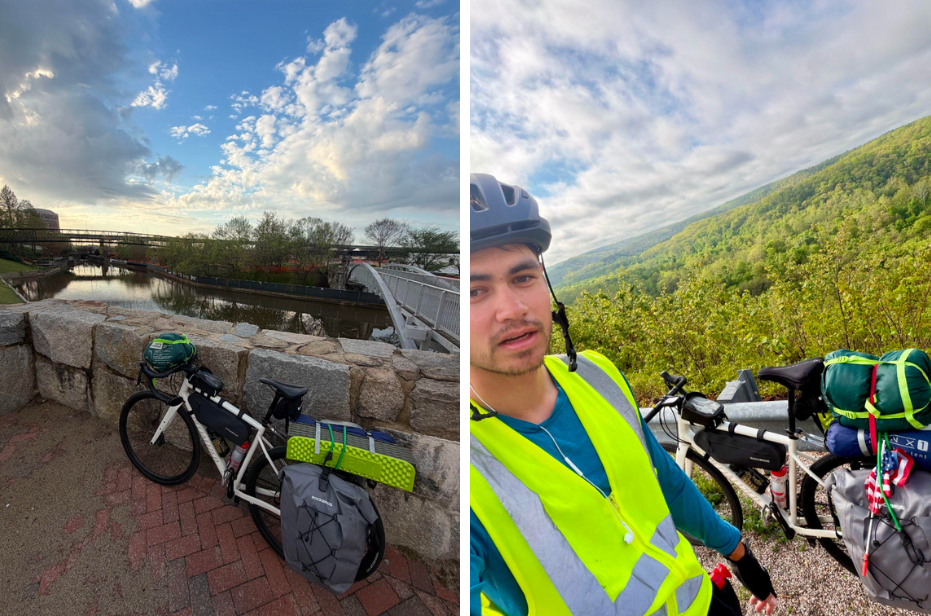
Image Credit: Cy Chittenden. Left: The official starting point on his trip – The James River in Downtown Richmond, VA. Right: Biking through the Ozark mountains in Missouri
There were rougher stretches too. Long, hot days in the remote Mojave Desert with no food, water, or sign of civilization. A week of headwinds in Oklahoma that didn’t let up, pedaling at the pace of a slow jog.
The last day was one of the worst. The interstate dropped out of the mountains into the Los Angeles basin in heavy fog, visibility so low he couldn’t see 50 feet ahead. Eighteen-wheelers blasted past him. He pulled over, stuck out a thumb, and waited for someone to stop. A highway patrol officer gave him a ride down the mountain.
The deeper reason he’s out here predates the bike. “Working as an EMT and volunteering in hospitals, you spend a lot of time with people who’ve lost the ability to move the way they want to,” said Chittenden. “I’m constantly reminded that not everyone gets to choose how hard they push their body. I knew biking 8 to 12 hours a day for a month was going to be physically and mentally rough, but being in a position to even attempt it is something I don’t take for granted.”
Since October, he’s also been a part-time lab technician on the ELITE study itself, sequencing other people’s genomes alongside his own. The work has shifted how he thinks about endurance.
“The more I’ve dug into sports physiology, understanding what’s actually happening at the cellular level during exercise, the more I’ve come to think of the body as an incredibly complex machine,” said Chittenden.
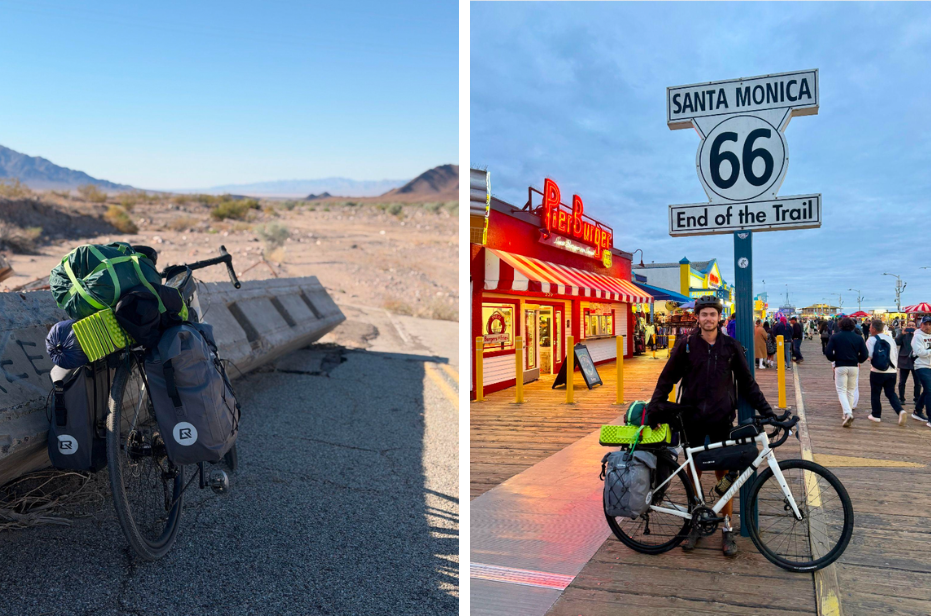
Image credit: Cy Chittenden. Left: A washed out road in the Mojave Desert in California. Right: End of Route 66 at the Santa Monica Pier
In the same way you’d grease a chain or swap in grippier tires for rough roads, he says, you can tune the systems driving endurance: diet, sleep, strength training, recovery. Genetics may set a ceiling, but he thinks that ceiling is higher than most people assume, and that it moves. He’s evidence of his own argument.
“When I joined my middle school cross country team, I had no expectation of competing in college,” he said, “let alone biking across the country.”
The ELITE study is still recruiting. Participation takes up to 15 minutes and can be done entirely remotely. If you think you might qualify, visit the study’s website to check the VO2max threshold — most GPS running watches with a heart rate sensor will give you an estimate. If you meet the threshold, the team will send you a collection tube. From a saliva sample, the team extracts and sequences the DNA to build an extremely detailed picture of the genetic determinants of elite physical endurance.
The ELITE study is funded by the Wu Tsai Human Performance Alliance.
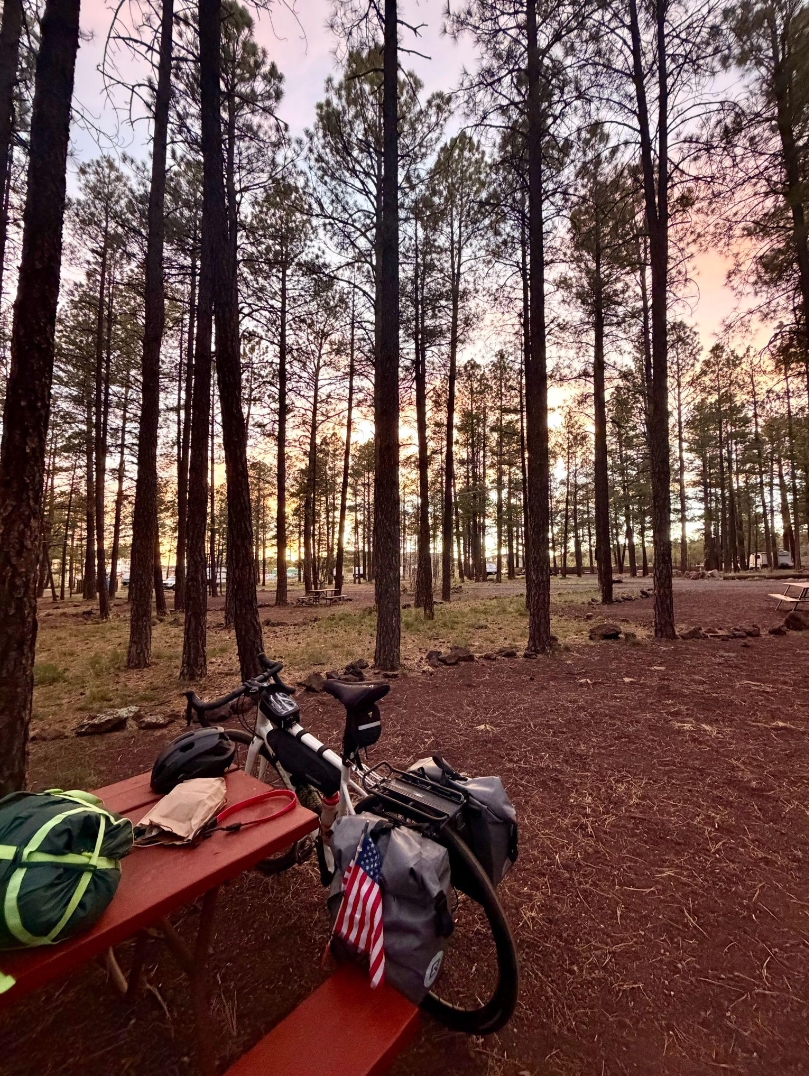
Image Credit: Cy Chittenden. Chittenden’s favorite campsite in Flagstaff, Arizona
Latest News

September 24, 2026
Wu Tsai Human Performance Alliance welcomes Emory Human Performance Institute, expanding Innovation Hub network
September 22, 2026
Alliance Round-Up: REDs risk markers, heat and iron absorption, and more

September 8, 2026
A wearable device tracked over 42,000 menstrual cycles. Here’s what researchers found
Get Engaged
Join our mailing list to receive the latest information and updates on the Wu Tsai Human Performance Alliance.